
Hard Water Spots: A Loganville, GA Cleaning Guide
- Hard water is dissolved minerals that form carbonate scale when water evaporates, not a cleaning failure.
- Clean in two steps: degrease to remove soap scum, then apply acid while kept wet to dissolve mineral scale.
- Never use acid on natural stone, granite or quartz sealants, grout, aluminum, brass, or unlacquered bronze.
- Prevent buildup: squeegee after showers, dry faucets, run exhaust fan, use dishwasher rinse aid, consider a water softener for wells.
You clean the shower on Saturday. By Wednesday, the glass has a cloudy haze again, the faucet has a chalky ring, and the dishes coming out of the dishwasher look like they were dried with a dirty towel. Nothing is actually dirty. What you’re looking at is mineral buildup — and it’s one of the most common cleaning frustrations we hear about from homeowners in Loganville.
Hard water spots aren’t a housekeeping failure. They’re chemistry. And once you understand what the deposit actually is, removing it stops being a battle of elbow grease and becomes a matter of using the right product in the right order.
This guide explains what mineral buildup is, why it shows up so persistently in this part of Gwinnett and Walton County, how to remove it safely surface by surface, and — importantly — which surfaces you should never attack with a descaler.
What Hard Water Spots Actually Are
“Hard” water simply means water carrying dissolved minerals, mostly calcium and magnesium. When that water evaporates off a surface, the water leaves but the minerals stay behind as a thin crust of carbonate scale. Repeat that a few hundred times on a shower door and the deposit stops being a spot and becomes a bonded layer.
Two details matter for cleaning:
- Scale is alkaline, so it dissolves in acid. That’s why an acidic cleaner works and why an all-purpose spray — which is usually mildly alkaline and designed for grease — does almost nothing to it.
- Soap scum is a different substance. Soap scum is a waxy compound formed when soap reacts with those same minerals. It responds better to a degreasing surfactant and gentle mechanical agitation. Most cloudy showers have both problems layered on top of each other, which is exactly why one product never seems to fully work.
The professional sequence is: degrease first to remove the soap-scum layer, then apply an acid to dissolve the mineral layer underneath. Doing it in the reverse order wastes the acid on a greasy film it can’t penetrate.
Why Loganville Homes See It So Clearly
Loganville straddles the Gwinnett–Walton county line along the Highway 78 corridor, and homes here fall into two broad groups that both make mineral spotting more visible than average.
Newer subdivisions with glass and chrome
The residential growth of the last two decades filled Loganville with homes featuring frameless or semi-frameless glass shower enclosures, polished chrome fixtures, undermount stainless sinks, and granite or quartz counters. These are the four surfaces where mineral deposits are most visible. A 1980s home with a fiberglass tub surround and a textured laminate counter hides the same water chemistry almost completely.
Older homes and private wells
On the Walton County side and out toward the more rural edges of the service area, a number of homes still draw from private wells, which typically carry a higher and more variable mineral load than treated municipal supply. Those households usually see faster scale return, and often iron staining as well — the orange-brown tint in a toilet bowl or at the back of a sink that no amount of bleach removes. Bleach actually oxidizes iron and can set the stain darker.
Georgia summers accelerate it
Evaporation is what leaves the deposit behind, so heat and airflow speed the process. A hot Loganville July, a bathroom fan running after every shower, and a full house of people bathing daily produce visible spotting far faster than a cool, quiet March.
How to Remove Mineral Buildup, Surface by Surface
Glass shower doors
Spray a dish-soap solution and let it dwell five minutes to release the soap-scum layer, then wipe. Next, apply white vinegar warmed slightly, or a commercial calcium-lime-rust product, and — this is the step most people skip — keep it wet. Acid only works while it’s in liquid contact with the deposit. Saturate a paper towel or cloth, press it flat against the glass, and let it sit 10 to 15 minutes. Then agitate with a non-scratch white nylon pad and rinse thoroughly. For heavily bonded scale, expect two cycles rather than one aggressive scrubbing session.
Chrome and stainless fixtures
Wrap a vinegar-soaked cloth around the base of the faucet and the aerator and secure it with a rubber band for 15 minutes. Rinse and buff dry with a microfiber cloth. Never use an abrasive powder or a scouring pad on chrome — the plating is thin, and micro-scratches make future deposits cling harder.
Toilets with a hard-water ring
Shut the supply valve, flush to lower the water level, then apply an acidic bowl cleaner directly to the exposed ring and let it dwell. A pumice stone rated for porcelain is the professional tool for the final pass — used wet, on wet porcelain, with light pressure. Dry pumice on dry porcelain will scratch.
Dishwashers and coffee makers
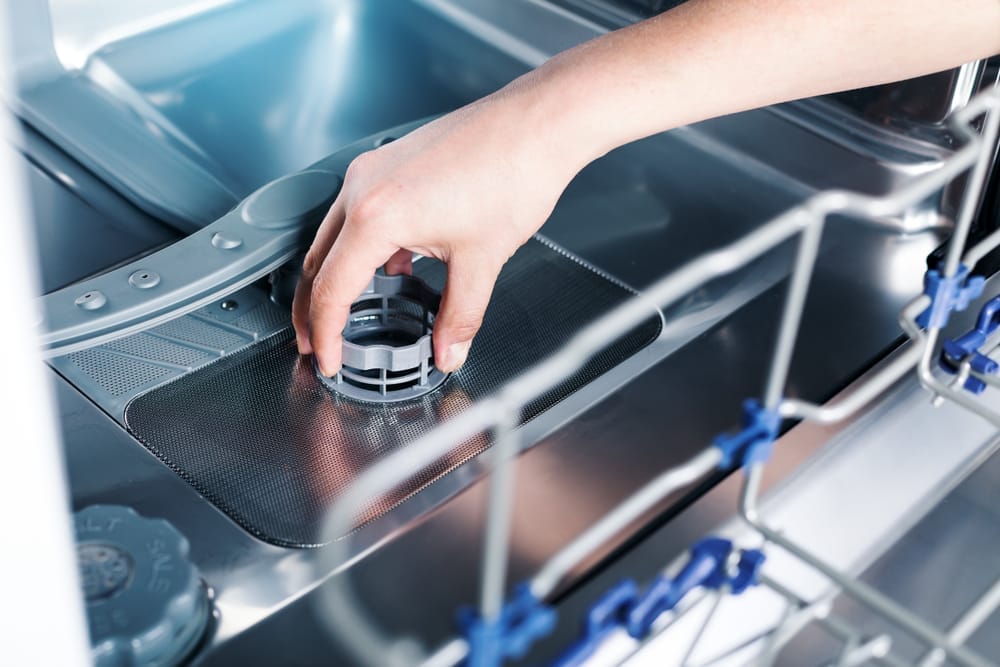
Run an empty dishwasher cycle with a cup of white vinegar or a citric-acid dishwasher cleaner on the top rack, and check the filter for grit. Descale coffee makers monthly — internal scale insulates the heating element, so the brew temperature drops and the coffee genuinely tastes worse before you ever see a deposit.
Showerheads
Unscrew the head, soak it in a vinegar bath for an hour, then clear each nozzle with a toothbrush. If the spray pattern has become uneven or sideways, that’s clogged nozzles, not a failing fixture.
Surfaces You Should Never Treat With Acid
This is where well-meaning DIY cleaning causes permanent damage, and it’s the part we most want homeowners to know:
- Natural stone — marble, travertine, limestone. These are calcium-based, so an acid will etch the stone itself, leaving a dull ring that cannot be wiped away. Use a pH-neutral stone cleaner only.
- Granite and quartz sealants. Repeated vinegar exposure degrades the sealer and, on quartz, can dull the resin binder. Warm soapy water is the correct daily approach.
- Grout and natural-stone tile joints. Acid erodes cementitious grout over time, leaving it sandy and prone to staining.
- Aluminum, brass, and unlacquered or oil-rubbed bronze finishes. Acid discolors them, often unevenly.
One more universal rule: never mix an acidic cleaner with bleach. The combination releases chlorine gas. If you’ve used a bleach-based product in a bathroom, rinse the surfaces thoroughly and ventilate the room before switching to anything acidic. The CDC’s guidance on chlorine exposure is a good reminder of why this isn’t a minor precaution.
Preventing Buildup Instead of Fighting It
Removal is the hard part. Prevention is genuinely easy once it becomes habit:
- Squeegee the shower glass after the last shower of the day. Thirty seconds prevents the deposit from ever forming — by far the highest-return cleaning habit in a hard-water home.
- Dry the faucet and sink rim with the hand towel you already used. No spot forms if no water evaporates in place.
- Run the exhaust fan for 15 to 20 minutes after showering to move humid air out rather than letting it condense on cool surfaces.
- Use a rinse aid in the dishwasher; it reduces surface tension so water sheets off glassware instead of beading and drying into spots.
- Consider a water softener or a whole-home filter if you’re on a private well and cleaning every surface twice a week. It’s a real expense, but for some households it’s cheaper than the time and the fixtures.
When to Bring in a Professional
Honest answer: routine spotting is a DIY job, and the steps above will handle it. Where professional help earns its keep is years of bonded scale — glass that has gone permanently frosted, toilet rings that have hardened into a shelf, or a whole-house restoration before selling or moving in. That work requires the right acid concentration, correct dwell times, and knowing which surfaces to protect. Done wrong, it costs more than it saves. It also tends to be the difference between a shower door that looks acceptable and one that looks new.
Common Questions About Hard Water Spots
Does vinegar work as well as a commercial descaler?
For light and moderate deposits, yes — vinegar is roughly a 5% acetic acid solution and is perfectly capable. For thick bonded scale, commercial calcium-lime-rust products are stronger and faster because they use a higher-strength acid. Ventilate the room and wear gloves either way.
Why do my glasses come out of the dishwasher cloudy?
Usually mineral film, which a citric-acid cleaner and a rinse aid will resolve. If a vinegar soak doesn’t clear it, the glass may be permanently etched from long-term exposure — that damage is in the glass itself and cannot be cleaned off.
Can hard water damage my plumbing?
Over many years scale can narrow pipe interiors and shorten water-heater life by insulating the heating element. It’s a slow problem, not an emergency, but it’s the main practical argument for softening if you’re on a well.
How often should a hard-water bathroom be deep cleaned?
With daily squeegeeing, a thorough descaling every two to three months is plenty. Without it, most Loganville homes need attention monthly to keep glass and fixtures from turning permanently hazy.
Local Help With Hard Water Cleaning
Our teams work in hard-water homes across the Highway 78 corridor every week, and we tailor our approach to the surfaces in each house rather than using one spray for everything. You can learn more about our house cleaning services in Loganville, GA, and we serve neighbors nearby in Lawrenceville and Grayson as well.
For an overview of recurring plans and deep cleaning, visit our cleaning services page.
And if you’d rather stop negotiating with your shower door altogether, request a free quote. We’ll build a simple recurring plan that keeps mineral buildup from ever getting a head start.
Share this article
Related Posts


Follow us
A quick overview of the topics covered in this article.